


Northwest Science - Accepted Articles and Notes
Northwest Science 100(1)
Management of forest adaptation to climate change requires an evolutionary lens: lessons from bark beetles in western North American conifer forests - Diana L. Six
Forest adaptation to climate change is becoming a management priority, yet in situ genetic adaptation via natural selection is rarely incorporated into planning. Instead, strategies emphasize resistance and resilience—short-term properties that do not ensure long-term forest persistence and function. Conifer forests harbor high genetic diversity shaped by long evolutionary histories with climatic variability and disturbance, fostering local adaptation, phenotypic flexibility, and complex biotic interactions. These attributes are central to the persistence of long-lived, sessile species. Here, I review western conifer forests through an eco-evolutionary lens, focusing on genetic resilience and interactions with co-evolved disturbance agents, particularly tree-killing bark beetles. I evaluate how prevailing management approaches may constrain natural selection and adaptive capacity and argue that passive or semi-passive strategies that allow selection to operate may better support long-term adaptation. Advancing such eco-evolutionary forestry will require a shift away from practices that prioritize short-term outcomes that neglect evolutionary processes and genetic consequences.
The complete pre-print version of this article is available here.
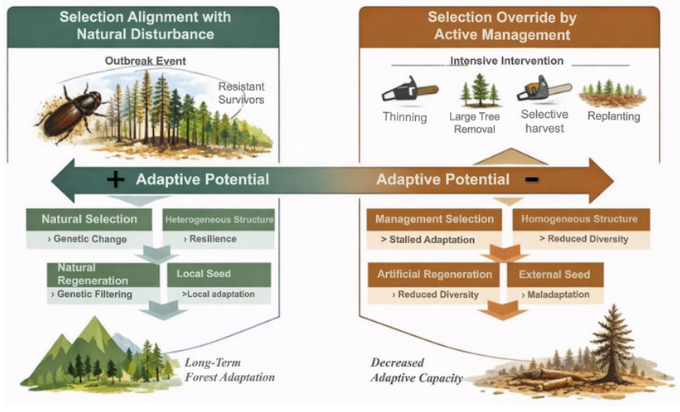
Figure 2. Management choices can be viewed along a continuum from selection alignment to selection override.
Northwest Science 99(4)
Reduced survey intensity has minimal impact on goose status and trend estimation at a Pacific Northwest refuge - Jennifer H. Herner-Thogmartin, Khemarith J. So, Shawn W. Stephensen, Wayne E. Thogmartin
Monitoring key ecological attributes helps land managers understand the current state of the resource and determine needed actions. We assessed whether reduced sampling intensity of winter goose populations at Nestucca Bay National Wildlife Refuge, Oregon, affected management-relevant inferences about species status and trend. Using sub-sampled survey data (2007–2019), we evaluated whether lower sampling frequencies maintain accurate and precise population estimates and trend detection. We analyzed five metrics: first arrival date, peak abundance date, maximum count, last departure date, and goose use days. Two alternative sampling schedules—fortnightly (every other week) and monthly—were compared to the status quo weekly sampling. Fortnightly, but not monthly, sampling produced estimates only slightly biased (≤ 4% lower) and similarly precise to weekly sampling. Season start and end were consistent across schedules, but peak day and maximum count varied more with reduced sampling. Detecting a 5% mean annual change in total goose use days with 80% power required 7–8 years of data, regardless of sampling intensity. Aleutian geese showed similar power, while Dusky Canada geese required over a dozen years to detect the same trend. Power increased with the mean:variance ratio, indicating more abundant species were better sampled for trend detection. In conclusion, reducing sampling from weekly to fortnightly had minimal impact on status and trend inferences, improving efficiency without compromising data quality. Optimizing the sampling schedule for wintering waterfowl balances cost and staff time constraints without sacrificing data quality.
The complete pre-print version of this article is available here.
A geographically extensive camera survey demonstrates limited presence of Pacific marten on Washington’s Olympic Peninsula - Dylan Hubl, Patti Happe, Betsy Howell, Robert Long, Paula MacKay, Aaron J. Wirsing
Pacific martens (Martes caurina) on Washington’s Olympic Peninsula appear to have suffered an extreme range contraction owing to anthropogenic pressures and are now thought to occupy only high-elevation forests. Multiple surveys since 1991, targeting forest carnivores and martens specifically, have yielded very few marten detections. Between 1968 and 2022, there were only 26 verified marten detections on the Olympic Peninsula. We implemented an occupancy study using a novel technology—automated scent dispensers—and remote cameras that allowed us to survey through the winter in high-elevation forests. We used a geographically extensive sampling frame to survey 67 sites in Olympic National Park and Olympic National Forest. We paired hair-snare devices with automated scent dispensers, opportunistically collected scat samples, and deployed transects of hair-snare devices in sample units where martens had recently been detected to collect marten DNA samples. We detected martens in only five sample units and no martens were identified via genetic sampling of 41 hair samples and 24 scat samples, further suggesting the limited presence of martens on the Olympic Peninsula and precluding our ability to conduct a full occupancy analysis. We recommend that future marten surveys on the Olympic Peninsula focus on confirming and delineating population core areas through intensive rather than extensive surveys.
Transplanting fern mats into young tree crowns: a step towards canopy ecosystem restoration in regenerating redwood forests - Marie E. Antoine, Stephen C. Sillett
Primary redwood forests of California often support epiphytic vascular plants, but heavy epiphyte loads are restricted to large old rainforest trees with complex crowns. Vascular epiphytes are almost entirely absent from secondary redwood forests even where climate permits due to a dearth of appropriate tree crown structure for epiphyte establishment. A single fern species, Polypodium scouleri, dominates redwood epiphyte communities and builds habitat for other arboreal lifeforms. Epiphyte transplanting is worthwhile when host trees are granted protection to attain full stature and longevity. Here we investigate the feasibility of transplanting P. scouleri sporophytes into relatively young (108–132 year old) redwood trees designated for permanent retention in a northern Humboldt County working forest. Typical young tree branches were less effective as transplant sites than crotches formed by trunk reiteration. Crotch mats were in better condition than branch mats throughout the 4.5-year study period, but crotches were scarce in young redwoods. Larger mats were more likely to fall than smaller ones, although larger surviving mats remained in better condition than smaller ones. All surviving mats had new cohorts of shorter fronds relative to initial transplant units, demonstrating predictable leaf trait adjustments for facultative epiphytes adjusting to exposed habitats. In this pilot study we demonstrate that P. scouleri can be successfully introduced to redwood crowns in secondary forests. Combining variable retention forestry with successful epiphyte transplanting could be a viable pathway towards restoring canopy ecosystems on regenerating timberlands.
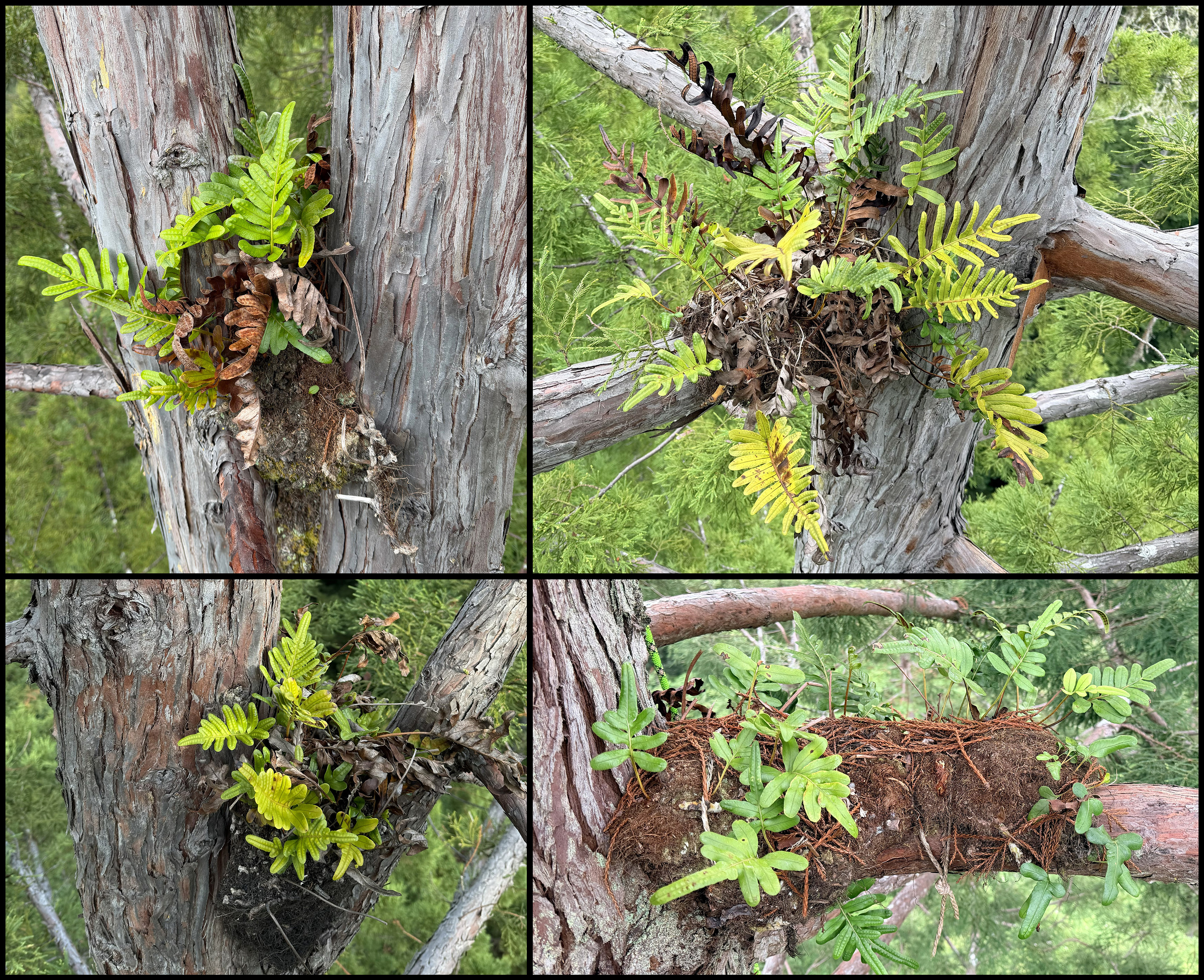
Figure 5. Examples of successful transplants of Polypodium scouleri fern mats. On left, crotch transplants are well established after 4.5 (above) and 2.0 (below) years aloft. On right, branch transplants are well established after 2.5 (above) and 4.5 (below) years aloft.
Research Notes
Precision of Northern Pike age estimates using four calcified structures - Luke M. Anderson, Ryan S. Hardy, Matthew P. Corsi, Michael C. Quist
Age and growth data provide valuable information for the management of fish populations. However, the quality of data is often a function of the choice of structure used to evaluate age and growth. Here, we compared ages of Northern Pike Esox lucius estimated using four calcified structures: sagittal otoliths, cleithra, pelvic fin rays, and pectoral fin rays. Northern Pike were sampled from Lake Pend Oreille, Idaho, using experimental gill nets. Northern Pike varied in length from 320 mm to 1,173 mm and estimated ages varied from 1–7 years. We found high levels of precision and agreement across all readers and structures. Percent exact agreement between readers varied from 90.0 to 95.3% and coefficients of variation varied from 1.3 to 3.0%. Percent exact agreement in consensus age estimates varied from 92.9 to 98.2% and coefficients of variation varied from 0.5 to 1.9% between structures. Otoliths generally had the lowest precision and required more intensive processing than other structures. Pelvic fin rays typically provided the same ages as pectoral fin rays but had higher average confidence. Pelvic fin rays are likely the best structure for ageing Northern Pike as they can be removed without sacrificing the fish, provide age estimates concordant with structures known to provide accurate ages, and are easy to read with moderate preparation.
The complete pre-print version of this article is available here.
Evaluation of Fin Rays and Otoliths for Estimating Age of Shoshone Sculpin - Michael C. Quist, Darby J. McMartin, Matthew P. Corsi, Brett J. Bowersox
Information on age and growth is central to understanding fish population dynamics and guiding conservation activities. However, using hard structures to age fishes from systems with stable water temperature has been largely ignored. We removed sagittal otoliths and pectoral fin rays from Shoshone Sculpin (Cottus greenei), a species endemic to spring systems in south-central Idaho, sampled from two spring systems during January–February, 2026. Otoliths and fin rays were mounted in epoxy and sectioned. Two readers independently aged the structures. Fish (n = 37) varied in length from 46–153 mm (total length). Otoliths typically had discernable marks that were interpreted as annuli. Fin rays were deemed unsuitable for ageing and removed from the analysis. Assuming marks were annuli, Shoshone Sculpin varied from age 2 to age 8. Results of this research are consistent with other studies focused on using otoliths to age fishes in stable, spring habitats, and ages are concordant with research on other freshwater cottids. This study provides an important foundation for future research focused on validating annulus formation and characterizing the ecology of Shoshone Sculpin.
The complete pre-print version of this article is available here.
Northwest Science 99(3)
Evaluating methods of detection for an elusive mesocarnivore in the Oregon Cascades - Marwa Mahmoud, Kalysta Adkins, Jade Keehn, Daniel Thornton
Mesocarnivores play fundamental roles in ecosystems. Yet in remote areas with difficult or limited access, many mesocarnivores can be challenging to study. The Sierra Nevada red fox (SNRF) is an elusive mesocarnivore and subspecies of red fox that is native to the Sierra Nevada mountains of California and Cascade mountains of Oregon and California and is listed as an endangered distinct population segment in the Sierra Nevada portion of its range. Little is known about the extent of SNRF distribution in Oregon and there has been a lack of systematic survey effort to effectively detect the species. We assess the effectiveness of two techniques for generating broad-scale information on SNRF distribution – camera traps and visual scat surveys. We focus on probability of detection within an occupancy framework as our measure of effectiveness and test the influence of several variables on detection probability for these two techniques. We conducted surveys in central Oregon, detecting red fox 118 times on cameras and 48 times from scat surveys. We found that non-lured, on-trail cameras had the highest probability of detecting SNRF. Although human performed scat surveys did not yield as many SNRF detections as on-trail camera surveys, in some cases detections were complementary to those from cameras, and when analyzed, scats can provide valuable genetic information on species identification, diet, survival, and reproduction. Considering these two techniques can be performed at the same time, we recommend that survey efforts targeting SNRF across their historical range should integrate on-trail camera and scat surveys.
Piscicolid leech infestations affect Northern Pike physiology at extreme levels - Kevin M. Fraley, William T. Samuel, Morag Clinton, Taylor Cubbage, Joseph Spencer
Recreational anglers noted abnormally high numbers of fish leeches (Piscicolidae) attached to Northern Pike at a shallow lake in Interior Alaska, anecdotally related to reduction in habitat availability during winter months. In response, we examined forty-two pike caught through the ice in 2023–2024 to characterize the prevalence and intensity of leech infestation, investigate the possible association of infestation with fish condition, and explore possible connections between leech load and contaminants that could impact fish immune response. Typical numbers of leeches found on fish in nearby water bodies are < 10 per individual. However, we found Northern Pike with as many as 481 leeches, commonly attached to their skin, gills, mouth, and fins. This represents the most intense infestation of fish leeches ever recorded in wild freshwater fish. Qualitatively, pike carrying high numbers of leeches exhibited serious damage to the skin. Lipid content estimates indicated that pike body condition was negatively associated with leech load when infested by more than two leeches per cm of fish length. There appears to be no link between contaminants and leech infestation, although 27 % of pike from the lake contained levels of total mercury warranting a 16 meal/month fish consumption recommendation for sensitive populations. The effects of very high leech loads on the physiology, reproductive potential, and survival of individual pike are likely negative, and warrant future study. Overall, this investigation represents important documentation of a potential stressor to high latitude fishes, as well as data for comparison in scenarios where climate change or anthropogenic impacts affect parasite-host dynamics.
The complete pre-print version of this article is available here.
Wildfire increased stream flow and native salmonid production in Stapaloop Creek - Chris Fisher, Benjamin Briscoe, Mark Roes, Ian Courter.
Contemporary forest management practices, including fire suppression, increases tree stand density relative to historic conditions. This may lead to reduced summer baseflows as snow interception and evapotranspiration increases, which may influence native salmonid productivity. We implemented a paired watershed study in two headwater streams within a heavily wooded area in northeast Washington State. From 2014 to 2018, we measured stream discharge, physical stream habitat characteristics, and fish densities in Stapaloop and Swimptkin Creeks, neighboring subbasins within the Omak Creek watershed. Initially, we planned to mechanically reduce basal area within the Stapaloop Creek drainage prior to comparing environmental responses between the two creeks. However, during the summer of 2015, a wildfire burned over half of the Stapaloop Creek drainage at moderate to high severity. As a result, base flows in Stapaloop Creek increased 35.7% compared to Swimptkin Creek and native Rainbow Trout density responded positively, while density of non-native Eastern Brook Trout decreased. Brook Trout and Rainbow Trout densities in Stapaloop Creek returned to pre-fire levels three-years later, but streamflow remained higher compared to the control watershed. Our results suggest that largescale reduction in tree stand density can cause changes in streamflow that provide benefits to native salmonid populations where fire suppression has been practiced and timber harvest occurs infrequently. Future research should consider both native and non-native species, as well as multiple timescales, when investigating the response of fish populations and their habitat to changes in streamflow following disturbance such as wildfire and forest thinning.
The complete pre-print version of this article is available here.
Research Notes
Feeding ecology of Great Basin spadefoot tadpoles - Saac Lee, Scot Erickson, Charles R. Peterson, Ken A. Aho, Jericho C. Whiting
The diet of Great Basin spadefoot (Spea intermontana) tadpoles is poorly understood in peer-reviewed literature. We recorded feeding events of spadefoot tadpoles during > 207 hours of spadefoot surveys from May to July 2022–2024 in southeast Idaho, USA. We opportunistically recorded 69 feeding events by tadpoles on 12 different prey items (differing life stages of the same prey species were considered distinct) with a mean feeding group size of 4 (sd = 7.9) spadefoots. The most frequently observed predator/prey interaction was spadefoot tadpoles foraging on conspecific tadpoles (n = 37). We also observed spadefoot tadpoles foraging on a leech (Annelida), dragonfly larvae (Anisoptera), feces from moose (Alces alces) and coyote (Canis latrans), fish (Actinopterygii), tadpole shrimp (Triopsidae), western tiger salamander (Ambystoma mavortium) tadpoles and carcasses, boreal chorus frog (Pseudacris maculata) carcasses, and spadefoot embryos. Our study documents the diverse diet of spadefoot tadpoles, including dead and living animals and plant matter, and provides new insights into the feeding patterns of Great Basin spadefoot tadpoles.
The complete pre-print version of this article is available here.
Northwest Science 99(2)
Research Notes
Establishing a long-term study on the population dynamics of Ptilosarcus gurneyi (orange sea pen) and observations of its interspecific interactions - Katie Shaw, Derek Smith
Ptilosarcus gurneyi (orange sea pen) is an ecosystem engineer which acts as structural habitat in sandy, subtidal ecosystems and has been largely overlooked in the Salish Sea for over fifty years. P. gurneyi is a colonial anthozoan from the family Pennatulacea that makes up large populations called “beds” along the northeast Pacific coast. Little is known about P. gurneyi’s current population dynamics, the makeup of its communities in the Salish Sea, or non-trophic interactions with other epifaunal organisms. The aim of this research was threefold: (1) to establish a long-term study on the site densities of a P. gurneyi bed in Burrow’s Bay, WA, (2) to approximate abundance of other epifaunal species in the bed, and (3) to observe interspecific interactions. To establish a long-term study site, four 100 square meter quadrants were set up as permanent plots which were surveyed by scientific divers. Site densities were calculated and compared to those of random transects in the bed to test if the permanent plot was representative of the average P. gurneyi density in Burrow’s Bay. Interactions and community makeup observations were taken using submerged cameras and direct field observations. A T-test determined that site densities from the plots and the random transects were significantly different from one another, however due to small sample size, it is recommended that this study be repeated to confirm significance. P. gurneyi was observed to be commensal and possibly mutualistic with multiple species. There is evidence to suggest that it may act as protection from high currents or predation. Future research could investigate how P. gurneyi population dynamics change at this site.
The complete pre-print version of this article is available here.